
Evaluation of Blood Transfusion in Postnatal Obstetric Patients at Latifa Hospital
Authors

Published
October 5, 2026
Paper ID
PAP-000001
Status
Published
DOI
10.65712/tmj.6679776
Advance Services
Abstract
Background and Objective: Obstetric transfusion is lifesaving, but institutional use varies. We determined the obstetric transfusion rate at Latifa Hospital and described recipient characteristics, indications, component use, and hematologic changes.
t tests.
Results: Among 3,000 deliveries, 200 women received transfusion, yielding a rate of 6.7% (95% confidence interval, 5.8%-7.6%). Mean age was 34.5 ± 6.3 years; 79.0% were multiparous, 74.5% delivered at term, and 84.5% underwent cesarean delivery. Postpartum hemorrhage or uterine atony accounted for 48.0% of transfusions, antenatal or chronic anemia and hematologic disorders for 20.5%, and genital-tract trauma for 10.0%. Two red-cell units were administered to 58.5% of women, and 7.5% received multiple components. Mean hemoglobin increased from 8.89 to 10.37 g/dL, a change of 1.48 g/dL (95% confidence interval, 1.34-1.63; P<0.001); hematocrit, red-cell count, and platelet count also increased significantly.
Conclusion: Obstetric transfusion followed two main pathways: acute hemorrhage, particularly uterine atony, and limited hematologic reserve associated with anemia. The findings support stronger hemorrhage detection and response, antenatal anemia management, and prospective audit linking indications to clinical outcomes. The data did not permit assessment of individual transfusion decisions.
Introduction
Obstetric hemorrhage is a complication in which minutes matter: once bleeding outpaces recognition and resuscitation, a previously healthy woman can progress rapidly to shock, coagulopathy, organ injury, hysterectomy, or death. Between 2009 and 2020, hemorrhage accounted for approximately 27% of maternal deaths worldwide, making it the leading direct cause of maternal mortality [1]. Postpartum hemorrhage (PPH) is excessive bleeding after birth; contemporary definitions emphasize the volume of cumulative blood loss and its hemodynamic consequences rather than a single laboratory value [2]. Its burden is not confined to low-resource settings. In a US analysis of 76.7 million delivery hospitalizations, the recorded rate of PPH increased from 2.7% in 2000 to 4.3% in 2019, and 12.6% of women with PPH received a transfusion in 2019 [3].
Blood transfusion lies at the critical end of this clinical continuum, but it is not synonymous with PPH. Uterine atony is the predominant cause of PPH, while retained placental tissue, placenta previa or accreta spectrum, placental abruption, genital-tract trauma, operative bleeding, and coagulation disorders account for important additional cases [2,3]. The need for transfusion also depends on the woman's hematologic reserve: pre-existing anemia reduces tolerance of even moderate blood loss and is associated with severe maternal morbidity [4]. Consequently, an institutional obstetric transfusion rate is a composite safety measure reflecting case mix, delivery mode, antenatal anemia, hemorrhage recognition, transfusion thresholds, local protocols, and blood-product availability; it cannot be interpreted as a direct measure of PPH incidence alone.
Allogeneic blood and blood components can restore oxygen-carrying capacity and support hemostasis during major bleeding, but their use also exposes women to transfusion reactions, circulatory overload, lung injury, alloimmunization, and a small residual risk of infection. Patient blood management (PBM) therefore integrates antenatal correction of anemia, prevention and rapid control of blood loss, targeted correction of coagulopathy, and clinically appropriate use of red cells and other components [5]. The decision to transfuse after bleeding has been controlled should not rely on hemoglobin concentration alone. In a multicenter randomized trial of hemodynamically stable women with acute anemia after PPH, transfusion produced only a small short-term improvement in fatigue and no difference in secondary clinical outcomes, supporting a selective approach in women without severe symptoms [6]. Meaningful institutional evaluation should therefore examine not only how often transfusion occurs, but also why it occurs, which components and doses are used, and the hematologic response that follows.
Published transfusion rates vary substantially between institutions and populations, limiting the transferability of benchmarks. A retrospective study from a tertiary center in Turkey reported an overall obstetric transfusion rate of 2.51%, with uterine atony and chronic anemia accounting for 50.7% and 32.9% of transfusions, respectively [7]. Evidence from the United Arab Emirates (UAE) remains limited. In the prospective Mutaba'ah cohort, which was restricted to singleton vaginal births, PPH occurred in 4.3% of women and 20% of those affected received a blood transfusion [8]. An earlier Dubai Health study described emergency peripartum hysterectomy and transfusion requirements in the most severe hemorrhage cases [9], but it did not characterize the broader population receiving obstetric transfusion. Thus, contemporary data spanning cesarean and vaginal delivery, hemorrhagic and nonhemorrhagic indications, component use, and post-transfusion laboratory response are still needed to support local PBM and hemorrhage-readiness programs.
We therefore conducted a retrospective descriptive study of women who delivered at Latifa Hospital, Dubai, during 2023 and received a blood transfusion intraoperatively or within six weeks after delivery; women transfused during the antenatal period were excluded. The primary objective was to determine the overall postnatal or intraoperative obstetric transfusion rate. Secondary objectives were to describe the demographic and obstetric characteristics of transfused women, identify the clinical indications for transfusion, quantify the blood products and number of units administered, and evaluate paired changes in hemoglobin, hematocrit, red blood cell count, and platelet count before and after transfusion. This record-based approach links the hospital delivery denominator with patient-level transfusion data and provides a center-specific benchmark for quality improvement.
Materials and Methods
Study design and setting
We conducted a descriptive, retrospective, cross-sectional study at Latifa Hospital, Dubai, covering women who delivered during calendar year 2023. The study used information already recorded in patient files; no study intervention or prospective follow-up was performed.
Study population and eligibility
The study population comprised women who delivered at Latifa Hospital and received a blood transfusion either intraoperatively or within six weeks after delivery. Records classified in the supplied study documents as antenatal transfusions were excluded. The total number of women who delivered at the hospital during the same study period provided the denominator for calculation of the transfusion rate.
Data sources and study variables
Data were abstracted retrospectively from existing patient files into a research data sheet and a parallel coded data sheet prepared for analysis. Extracted variables comprised maternal age; gravidity; gestational-age category; mode of delivery; documented indication for transfusion; blood product and number of units administered; and hemoglobin (Hb), hematocrit (Hct), red blood cell (RBC) count, and platelet count before and after transfusion.
The coded data categorized gravidity as primigravida or multiparous, gestational age as term or preterm, and delivery mode as vaginal delivery or lower-segment cesarean section. The supplied documents did not specify a gestational-week threshold for the term/preterm classification; therefore, the category recorded in the source data was retained without reclassification.
Indications for transfusion
The documented indication was coded and consolidated for analysis into the following clinical categories: postpartum hemorrhage or uterine atony; antenatal or chronic anemia and hematologic disorders; genital-tract trauma; antepartum hemorrhage or placenta previa; other intraoperative bleeding or adhesions; placental abruption; placenta accreta; and uterine fibroid-associated bleeding. The grouping reflected diagnoses recorded in the study data; no unrecorded diagnosis was assigned.
Blood products administered
Packed red blood cell exposure was categorized as 1, 2, 3, or 4 or more units. The coded data sheet also included a category labeled 'multiple-component (massive) transfusion' for combinations of packed red blood cells with fresh-frozen plasma, platelets, and/or cryoprecipitate. Administration of fresh-frozen plasma, platelets, and cryoprecipitate within this multiple-component category was recorded separately. Because the supplied files did not provide an operational unit or volume threshold for 'massive' transfusion, the source-data label was retained and no additional threshold was imposed.
Hematologic measurements
For each eligible record, the Hb, Hct, RBC count, and platelet count designated in the study data sheets as pre-transfusion and post-transfusion values were abstracted. Paired analyses used records in which both measurements for the relevant index were available. The supplied documents did not define the time windows used to select the pre- and post-transfusion samples; no unreported sampling interval was therefore assigned.
Outcomes
The primary outcome was the postnatal or intraoperative obstetric transfusion rate, calculated as the number of eligible transfused women divided by the total number of women who delivered during 2023, multiplied by 100. Secondary outcomes were the demographic and obstetric characteristics of transfused women, the distribution of transfusion indications, the products and numbers of units administered, and paired changes in the four hematologic indices.
Statistical analysis
Continuous variables were summarized using means and standard deviations (SDs); the observed range was also reported for maternal age. Categorical variables were summarized using counts and percentages. The transfusion rate was reported with a 95% confidence interval (CI). Pre- and post-transfusion laboratory values were compared using paired t-tests, and mean paired changes were reported with 95% CIs. Each paired comparison used the observations available for that hematologic index.
Results
During the study period, 3000 women delivered at Latifa Hospital. After exclusion of patients transfused antenatally, 200 women received a blood transfusion in the postnatal or intra-operative period, giving an overall postnatal transfusion rate of 6.7% (95% CI, 5.8 to 7.6). The enrollment of the cohort is shown in Figure 1.
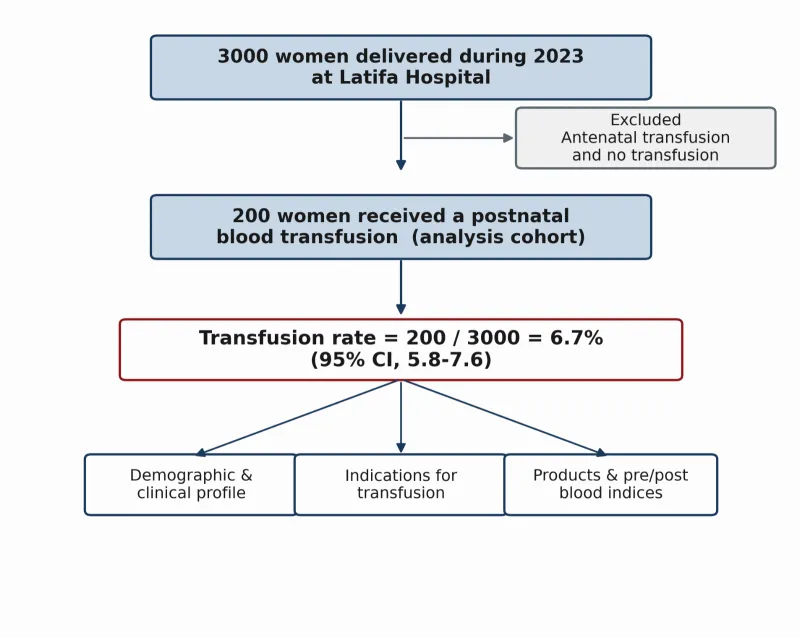
Of 3000 women who delivered in 2023, 200 received a postnatal blood transfusion, corresponding to a rate of 6.7%.
Characteristics of the Patients
The demographic and clinical characteristics of the 200 transfused women are summarized in Table 1. The mean age was 34.5 ± 6.3 years (range, 20 to 47). Most women were multiparous (79.0%), had reached term gestation (74.5%), and were delivered by cesarean section (84.5%).
| Characteristic | No. | % |
|---|---|---|
| Age — yr, mean ± SD | 34.5 ± 6.3 | |
| Gravidity — no. (%) | ||
| Primigravida | 42 | 21.0 |
| Multiparous | 158 | 79.0 |
| Gestational age — no. (%) | ||
| Term | 149 | 74.5 |
| Preterm | 51 | 25.5 |
| Mode of delivery — no. (%) | ||
| Cesarean section (LSCS) | 169 | 84.5 |
| Vaginal delivery (NVD) | 31 | 15.5 |
SD denotes standard deviation, LSCS lower-segment cesarean section, and NVD normal vaginal delivery. Percentages may not total 100 because of rounding.
Indications for Transfusion
The indications for transfusion are shown in Figure 2. Obstetric hemorrhage was the predominant cause, with uterine atony being the single most frequent indication (96 patients, 48.0%). Antenatal or chronic anemia and hematologic disorders accounted for 20.5% of cases, while genital-tract trauma accounted for 10.0%.
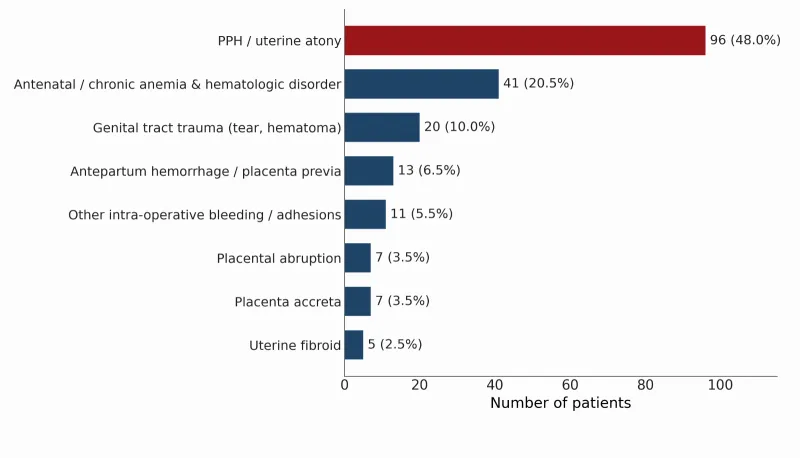
Values are numbers of patients, with percentages of the cohort in parentheses. The most common indication is highlighted.
Blood Products Administered
Packed red cells were the mainstay of transfusion; 58.5% of women received 2 units, the most common regimen (Table 2). A total of 15 women (7.5%) required a multiple-component (massive) transfusion combining packed red cells with fresh-frozen plasma, platelets, or cryoprecipitate.
| Blood product / regimen | No. | % |
|---|---|---|
| Packed red cells, by no. of units | ||
| 1 unit | 51 | 25.5 |
| 2 units | 117 | 58.5 |
| 3 units | 12 | 6.0 |
| ≥4 units | 5 | 2.5 |
| Multiple-component (massive) transfusion | 15 | 7.5 |
| Additional components (within massive group) | ||
| Fresh-frozen plasma | 13 | 6.5 |
| Platelets | 10 | 5.0 |
| Cryoprecipitate | 6 | 3.0 |
Packed red-cell categories are mutually exclusive and sum to 200. Additional components were administered within the 15 multiple-component transfusions and are therefore not mutually exclusive.
Change in Hematologic Indices after Transfusion
All measured hematologic indices increased significantly after transfusion (Table 3). Hemoglobin rose by a mean of 1.48 g/dL (95% CI, 1.34 to 1.63; P<0.001), from 8.89 g/dL before transfusion to 10.37 g/dL afterward. The distribution of individual hemoglobin responses is shown in Figure 3.
| Variable | Before transfusion | After transfusion | Mean change (95% CI) | P value |
|---|---|---|---|---|
| Hemoglobin — g/dL | 8.89 ± 1.08 | 10.37 ± 1.13 | +1.48 (1.34 to 1.63) | <0.001 |
| Hematocrit — % | 27.83 ± 4.75 | 31.83 ± 4.64 | +4.00 (3.41 to 4.59) | <0.001 |
| Red-cell count — ×10¹²/L | 3.50 ± 0.56 | 4.00 ± 0.57 | +0.49 (0.44 to 0.55) | <0.001 |
| Platelet count — ×10⁹/L | 217.54 ± 76.03 | 244.15 ± 90.65 | +26.61 (17.70 to 35.51) | <0.001 |
Plus–minus values are means ± SD. P values are from paired t-tests comparing pre- and post-transfusion values. CI denotes confidence interval. Values were available for 200 patients for all indices except platelet count (n = 198).
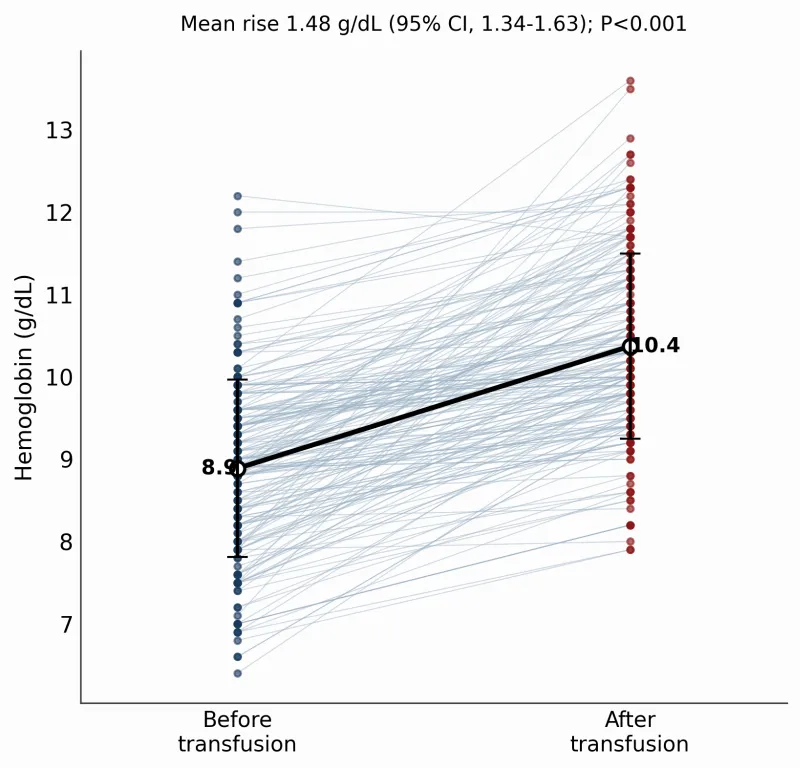
Thin lines connect paired values for each woman; the heavy line shows the cohort mean with error bars representing 1 SD. The mean hemoglobin rose from 8.9 to 10.4 g/dL (mean increase, 1.48 g/dL; P<0.001).
Discussion
In this hospital-wide cohort, approximately 1 in 15 women who delivered received a transfusion intraoperatively or within six weeks after birth. The pattern identifies two clinically distinct pathways to transfusion: acute obstetric bleeding, led by postpartum hemorrhage (PPH) or uterine atony, and reduced hematologic reserve, reflected by antenatal or chronic anemia and hematologic disorders. Red-cell support was generally limited to one or two units, whereas a smaller subgroup received multiple components. The paired laboratory changes confirm a measurable hematologic response after transfusion; however, without the clinical trigger, timing, and patient-centered outcomes, they do not by themselves establish that a transfusion was indicated or beneficial. The principal value of these findings is therefore the center-specific picture they provide of where obstetric blood use occurs and where prevention and audit are most likely to have impact.
The 6.7% transfusion rate was higher than the 2.51% rate reported by a tertiary center in Turkey [7], but the difference should not be interpreted as a direct performance comparison. The present denominator included all deliveries, while eligibility extended from the operating room to six weeks postpartum and encompassed hemorrhagic and nonhemorrhagic indications. By contrast, the UAE Mutaba'ah analysis was restricted to singleton vaginal births and reported transfusion within the subgroup with PPH rather than among all delivering women [8]; the US population study similarly reported transfusion among women coded with PPH [3]. The predominance of cesarean delivery among transfused women at Latifa Hospital may reflect referral patterns, operative case mix, placental disease, or the conditions that prompted cesarean delivery. Because the study did not include a nontransfused comparison group or the delivery-mode distribution of the source population, it cannot determine whether cesarean delivery independently increased transfusion risk.
PPH or uterine atony accounted for almost half of transfusions, closely resembling the 50.7% attributed to atony in the Turkish study [7] and reinforcing atony as the principal hemorrhagic target described in international guidance [2]. This concentration makes rapid recognition and coordinated first-response treatment a practical priority. In the international E-MOTIVE cluster-randomized trial, objective blood-loss assessment combined with a bundled response reduced severe PPH, laparotomy for bleeding, or death from bleeding and also reduced transfusion for bleeding after vaginal birth [10]. That trial population and intervention cannot be assumed to reproduce the same effect in this mixed-delivery Dubai cohort. Nevertheless, it supports an auditable pathway built around quantitative blood-loss assessment, timely uterotonics and tranexamic acid when indicated, examination for the source of bleeding, fluid resuscitation, and prompt escalation rather than isolated or sequential responses.
Antenatal or chronic anemia and hematologic disorders formed the second-largest indication group despite the exclusion of antenatal transfusions. This finding suggests that limited hematologic reserve remained clinically important when women reached delivery or the postpartum period. Maternal anemia is associated with severe maternal morbidity [4], and obstetric patient blood management places antenatal detection and correction of anemia alongside hemorrhage prevention and judicious component use [5]. For Latifa Hospital, the actionable implication is to connect transfusion surveillance with the antenatal pathway: document the anemia phenotype and severity, investigate its cause, record treatment and response, and identify women who reach delivery without adequate correction. The current records did not include ferritin, anemia etiology, prior treatment, or treatment response, so the proportion that was iron deficient or potentially preventable cannot be determined.
Two units of red cells was the most frequent regimen. That pattern may be appropriate during active bleeding, when resuscitation cannot wait for laboratory reassessment, but it also identifies a useful point for stewardship once bleeding is controlled. In a pragmatic randomized trial of hemodynamically stable women with postpartum anemia, an initial single-unit protocol avoided a second unit in more than 80% of women without worsening clinical or patient-reported outcomes [11]. Our data do not distinguish active hemorrhage from stable anemia at the time each unit was issued, and therefore cannot be used to judge the appropriateness of the two-unit regimens. They do support prospective documentation of stability and unit-by-unit reassessment in women for whom it is clinically safe. Similarly, the 7.5% multiple-component group probably represents a more severe bleeding phenotype, but the absence of a prespecified massive-transfusion threshold, quantified blood loss, coagulation results, fibrinogen concentration, and product timing precludes assessment of protocol activation or component ratios against PPH guidance [2,5].
Hemoglobin increased by a mean of 1.48 g/dL, accompanied by increases in hematocrit and red-cell count. In stable postpartum women assessed four to six hours after transfusion, a secondary analysis of a randomized trial found a mean hemoglobin increment of approximately 0.9 g/dL per red-cell unit [12]. The aggregate response in the present cohort cannot be compared unit for unit because it combined one-, two-, and higher-unit regimens, included acute bleeding indications, and lacked standardized sampling intervals. Ongoing blood loss, fluid administration, postpartum volume shifts, and the timing of measurement could each influence the observed change. The rise in platelet count is likewise not attributable to platelet transfusion alone because only a small subgroup received platelets. Most importantly, statistical improvement in laboratory indices is an expected biological effect of transfusion, not a substitute for symptom relief, hemodynamic recovery, avoidance of morbidity, or safe discharge. This distinction is consistent with randomized evidence showing limited clinical benefit from routine transfusion in selected stable women after severe PPH [6].
This study has several strengths. It links a complete calendar-year institutional delivery denominator to patient-level indications, product exposure, and paired hematologic data; it also includes cesarean and vaginal births and indications beyond PPH, thereby extending the limited UAE evidence base. The limitations are equally important. The retrospective, single-center design limits generalizability and is vulnerable to incomplete documentation and diagnostic misclassification. Without a nontransfused comparison group, the study cannot identify independent risk factors or support causal inferences. The supplied records did not define the exact case-identification process, clinical transfusion thresholds, quantified blood loss, vital signs or symptoms at transfusion, laboratory sampling windows, operative complexity, or the massive-transfusion threshold. Nor were transfusion reactions, intensive care admission, hysterectomy, length of stay, readmission, or maternal functional outcomes available. Two platelet pairs were missing, and the analyses were unadjusted. These omissions prevent assessment of appropriateness, safety, preventability, and risk-adjusted performance; they do not invalidate the descriptive benchmark.
A prospective obstetric transfusion registry would convert this benchmark into a stronger quality-improvement tool. For every delivery, such a registry should capture standardized PPH definitions, quantified blood loss, mode and urgency of delivery, antenatal hemoglobin and anemia treatment, physiologic and symptomatic triggers, timing and sequence of each component, coagulation and fibrinogen results, hemorrhage interventions, protocol activation, adverse reactions, and maternal outcomes. Repeated risk-adjusted audit could then distinguish appropriate lifesaving transfusion from potentially avoidable exposure and evaluate whether changes in anemia care or hemorrhage response improve outcomes. The goal should not be a lower transfusion rate in isolation, but timely transfusion for women who need it and fewer women reaching the point at which it becomes necessary.
Conclusions
In this retrospective study of 3,000 deliveries at Latifa Hospital in 2023, 200 women received an intraoperative or postnatal transfusion, establishing a center-specific rate of 6.7%. PPH or uterine atony was the leading indication, while antenatal or chronic anemia and hematologic disorders constituted a second major pathway; red cells, most often two units, were the predominant therapy, and a small subgroup required multiple components. The study provides a practical baseline but, because clinical triggers, standardized sampling times, a comparison cohort, and maternal outcomes were unavailable, it cannot determine causation or transfusion appropriateness. Its clearest implication is to integrate antenatal anemia optimization, standardized hemorrhage recognition and response, and prospective indication- and outcome-linked transfusion audit so that lifesaving blood is given promptly while avoidable exposure is reduced.
References
- Cresswell JA, Alexander M, Chong MYC, Link HM, Pejchinovska M, Gazeley U, et al. Global and regional causes of maternal deaths 2009-20: a WHO systematic analysis. Lancet Glob Health. 2025;13(4):e626-e634.
- Escobar MF, Nassar AH, Theron G, Barnea ER, Nicholson W, Ramasauskaite D, et al. FIGO recommendations on the management of postpartum hemorrhage 2022. Int J Gynaecol Obstet. 2022;157 Suppl 1:3-50.
- Corbetta-Rastelli CM, Friedman AM, Sobhani NC, Arditi B, Goffman D, Wen T. Postpartum hemorrhage trends and outcomes in the United States, 2000-2019. Obstet Gynecol. 2023;141(1):152-161.
- Harrison RK, Lauhon SR, Colvin ZA, McIntosh JJ. Maternal anemia and severe maternal morbidity in a US cohort. Am J Obstet Gynecol MFM. 2021;3(5):100395.
- Muñoz M, Stensballe J, Ducloy-Bouthors AS, Bonnet MP, De Robertis E, Fornet I, et al. Patient blood management in obstetrics: prevention and treatment of postpartum haemorrhage. A NATA consensus statement. Blood Transfus. 2019;17(2):112-136.
- Prick BW, Jansen AJG, Steegers EAP, Hop WCJ, Essink-Bot ML, Uyl-de Groot CA, et al. Transfusion policy after severe postpartum haemorrhage: a randomised non-inferiority trial. BJOG. 2014;121(8):1005-1014.
- asdasdasdasd
- Suliman A, AlZahmi A, Alnuaimi S, Alshomali DB, AlKaabi TK, Sameer ASN, et al. Postpartum hemorrhage following vaginal delivery and associated risk factors in the United Arab Emirates: the Mutaba'ah study. Womens Health (Lond). 2026;22:1-10.
- Tahlak MA, Abdulrahman M, Hubaishi NM, Omar M, Cherifi F, Magray S, et al. Emergency peripartum hysterectomy in the Dubai health system: a fifteen year experience. Turk J Obstet Gynecol. 2018;15(1):1-7.
- Gallos I, Devall A, Martin J, Middleton L, Beeson L, Galadanci H, et al. Randomized trial of early detection and treatment of postpartum hemorrhage. N Engl J Med. 2023;389(1):11-21.
- Hamm RF, Perelman S, Wang EY, Levine LD, Srinivas SK. Single-unit vs multiple-unit transfusion in hemodynamically stable postpartum anemia: a pragmatic randomized controlled trial. Am J Obstet Gynecol. 2021;224(1):84.e1-84.e7.
- Rush M, Srinivas SK, Hamm RF. Hemoglobin change after red blood cell transfusion for postpartum anemia: secondary analysis of a randomized, controlled trial. Am J Perinatol. 2024;41(7):831-833.